
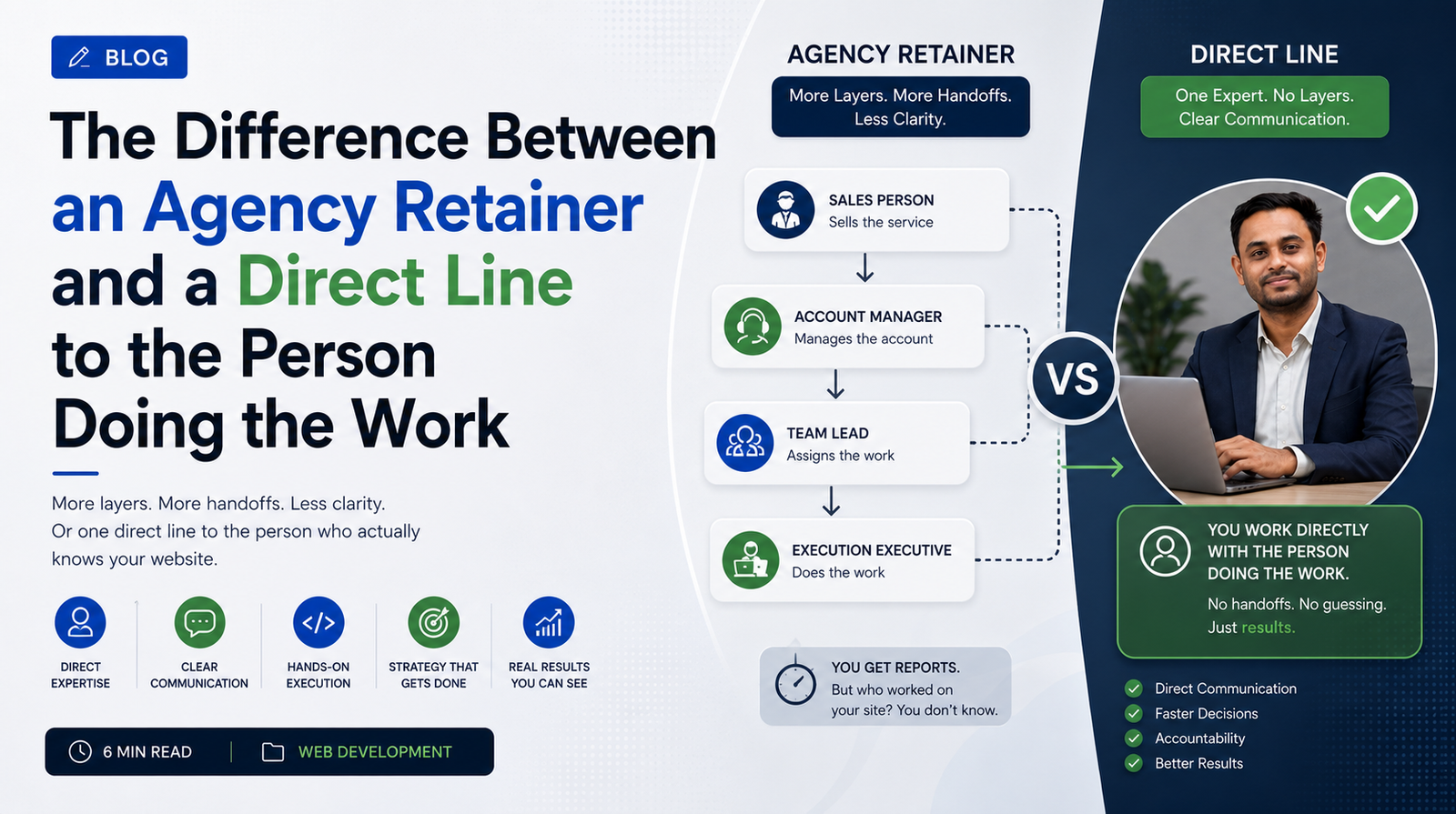
A business owner once described her previous SEO arrangement to me like this: "I paid a retainer for eight months and I still don't know who actually touched my website." She wasn't exaggerating for effect. She genuinely couldn't tell me. She had a monthly call with an account manager, a PDF report that arrived like clockwork, and no idea whether the person generating that report had ever opened her site's source code.
That conversation has stayed with me, because it's not a rare story. It's close to the default experience for a lot of businesses that sign up for an agency retainer expecting expertise and end up with a relay chain instead.
What Actually Happens Between the Pitch and the Work
Here's the part most businesses don't see, because they're not in the room for it. The person who sells you the retainer — confident, articulate, clearly knowledgeable — is very often not the person who ends up doing the work. That gets handed to whoever's available on the execution team that month. Sometimes that's someone excellent. Sometimes it's someone two months into the job, working from a template, managing fifteen other accounts at the same time.
None of this makes agencies dishonest. It's just how the economics of that model work. A retainer has to cover account management, sales, reporting infrastructure, and margin, on top of the actual specialist hours — which means the specialist hours are often the thinnest slice of what you're paying for, and the least visible one.
I've stepped into projects after this exact pattern more than once. A business had been paying for "SEO" for the better part of a year, and when I actually opened the site, basic things hadn't been touched. Schema markup was still throwing validation errors. A site's most valuable page had a canonical tag quietly pointing at the wrong URL, undoing months of paid link-building in one line of code nobody had checked. The monthly reports had been technically accurate and strategically meaningless — traffic numbers moving up and down for reasons that had nothing to do with anything anyone had actually done.
What Changes When There's No Layer In Between
When a business works with me directly, the difference isn't really about talent — plenty of agency specialists are excellent at what they do. The difference is what happens to information as it moves.
When I find a problem, there's no translation step. I don't write it up for an account manager to relay in simplified language on a call three days later. I see it, and I either explain it directly or fix it directly, often in the same sitting. When a client asks "why," they're asking the person who actually knows why — not someone reading from notes someone else prepared. When priorities shift, there's no ticket that has to work its way through someone else's sprint planning. The person deciding what to fix next is the same person who's going to fix it.
This also means accountability has nowhere to hide. If a fix doesn't work, there's no one else to point to. That's uncomfortable in a useful way — it keeps the standard high, because there's no layer of process to absorb the blame for a bad recommendation.
The Trade-Off Nobody Advertises
I want to be honest about the other side of this, because it's real. A specialist working directly can't offer the bandwidth a twenty-person agency can. I can't run five major campaigns in parallel the way a properly staffed team can. There's a ceiling on how much I can take on at once, and that's a deliberate trade-off, not an oversight.
What I've chosen is depth over breadth. Fewer clients, but every one of them gets the person who actually understands their site, their market, and their history — not a rotating cast filtered through account management. For a large enterprise running dozens of campaigns simultaneously, an agency's structure might genuinely be the right fit. For most of the businesses I work with — a resort in Kerala, a transportation company in Qatar, a mid-sized firm competing for commercial keywords in Riyadh — what they actually need isn't more hands. It's one set of hands that knows exactly what's happening on their site and never has to ask someone else first.
What to Actually Ask Before You Sign a Retainer
If there's one practical thing I'd tell any business evaluating an SEO or web partner, it's this: ask, plainly, who will actually be doing the work — by name — and whether that's the person you're talking to right now. Ask what happens when that person has a question about your site: do they answer it themselves, or check with someone else first? Ask to see an example of a fix they've shipped, not just a report they've written.
None of these questions are hostile. They're the same questions I'd want a client to ask me. The answers tell you, faster than any pitch deck can, whether you're about to build a relationship with a specialist or a relationship with a reporting system that has a person's name attached to it.
That business owner I mentioned at the start eventually did find out who'd been working on her site for those eight months. It turned out to be three different people across three different months, none of whom had ever spoken to her directly. She wasn't angry about it exactly — just tired, in the specific way people get when they've been paying for expertise and receiving process instead.
Want to know exactly who'll be doing the work on your website?
It'll be me, directly. Let's talk.
Discuss Your ProjectShare this article
If you found this helpful, pass it along.